


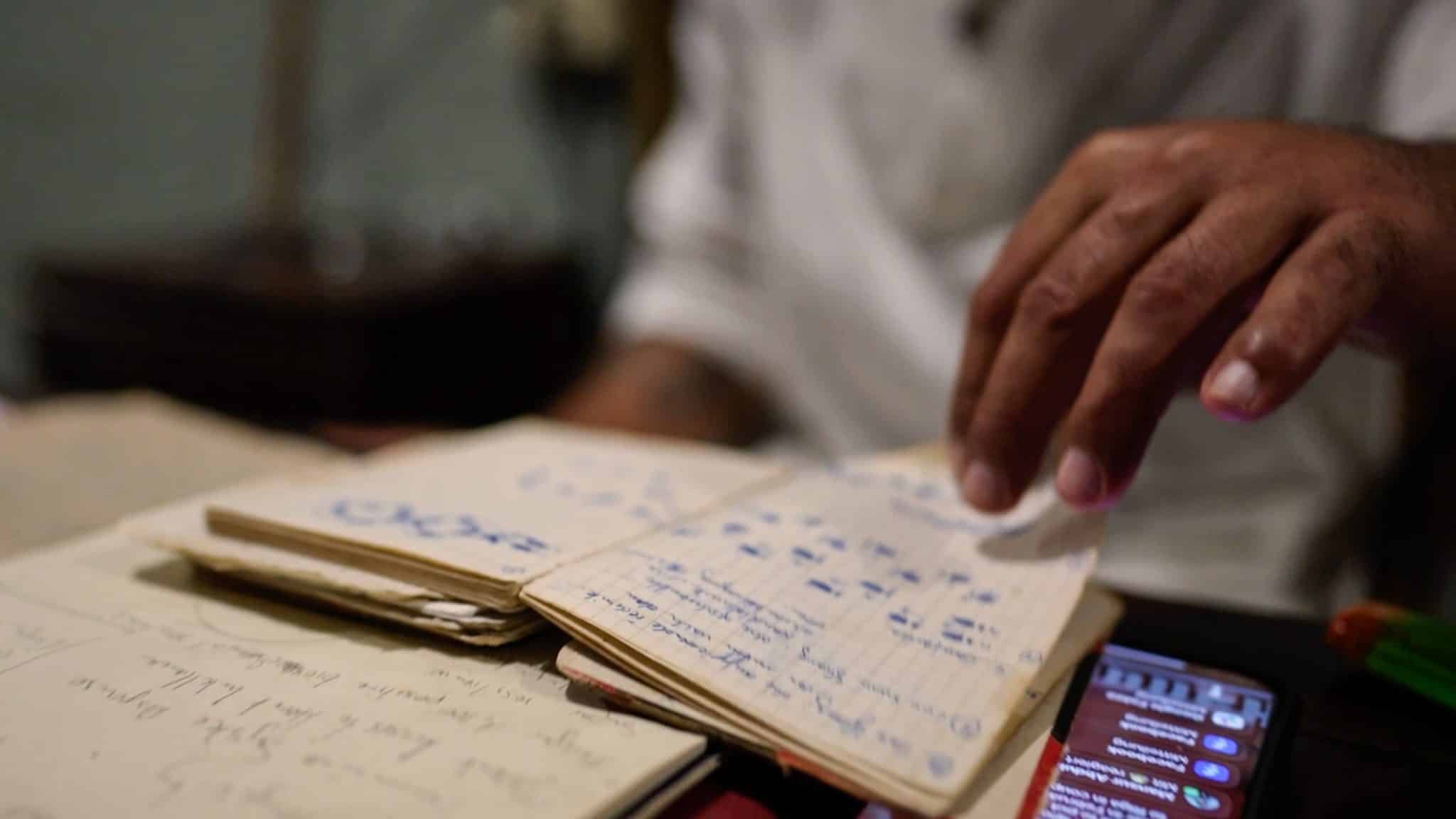
Going through decades worth of grandmaster's detailed notes. What is the difference between a master and an empty teacher?
During our visit to Taiwan, we went through some of the handwritten notes the grandmaster had collected over many years of training, research and learning from different masters.
The notes contain an enormous range of material: Tai Chi principles, body positions, footwork, breathing methods, meditation, standing practices, internal and external techniques, Wing Chun forms, Lohan methods and much more.
Some of them are so old that even the Grandmaster no longer remembers exactly when they were written.
What makes these notes interesting is not simply the amount of information inside them.
They represent decades of learning and mastery.
Grandmaster Jiang explains that the material comes from many different sources: teachings from many masters, books, his own experiences and his own understanding developed over time.
In the past, this kind of knowledge could easily disappear with one generation. And it's certain a lot of these ancient methods have been already lost.
If a teacher never passed it forward, or his students didn't do the same, the information could simply be lost.
This is one of the reasons we believe it is so important to document these methods today, and how important it has been to document the grandmaster's methods in the courses at WarriorNeigong.com.
These ancient methods can easily be lost, especially when the written form alone is not enough to preserve the real application of the knowledge.
In the last several decades the grandmaster documented the knowledge in his notes and students, and now in the courses we've created with him. We have also documented our journey of human body development in our Vahva programs.
Every individual goes through different phases in his life. The phase when the grandmaster was training seriously to fight in competitions is a very different phase than he is now when he is focusing more on inner development and teaching.
With the grandmaster's courses and our methods, you can find something for every stage and every challenge of your life.
In the future, I'm sure people will be beyond grateful that there was video technology to transmit this knowledge.
What Makes a Real Master?
Grandmaster Jiang Yu Shan makes an important distinction.
Being a master does not mean you need to be the UFC world champion or prove yourself by defeating everyone around you.
For him, mastery is connected to understanding. Most best teachers and coaches in the world are rarely the best practitioners of their teachings.
Was Cus D'Amato, the Mike Tyson's coach the best fighter? No, but he created one of the best fighters in boxing history.
A real teacher should understand how to develop another person.
The grandmaster describes himself first as a teacher and healer, someone whose responsibility is to preserve knowledge and pass it forward.
Authenticity is also extremely important.
You don't need special clothing, piercings or a mystical image to prove that you understand ancient knowledge.
You need substance, you need experience and most importantly, you need something real to teach.
This may ultimately be one of the most valuable lessons from these old notebooks —Knowledge has value only when it is understood, embodied and eventually passed forward.
The notes provide information but the teacher and his students keep it alive.
Now, thanks to modern technology this ancient lineage is accessible to you as well. You can discover the grandmaster's teachings at WarriorNeigong.com.
Stay strong.
